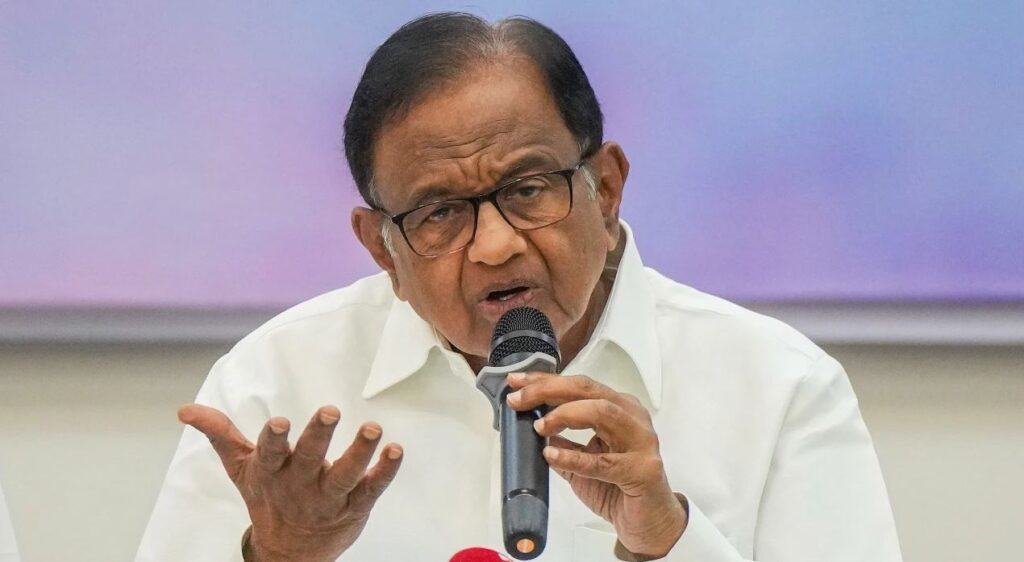
Senior Congress leader and former Union Minister P Chidambaram has raised serious concerns regarding the government’s timeline for restoring statehood to Jammu and Kashmir (J&K). On Wednesday, he described the abrogation of Article 370, which occurred seven years ago, as a “Constitutional outrage.”
Chidambaram’s remarks coincided with the seventh anniversary of the landmark decision that stripped J&K of its special status and bifurcated the region into two Union Territories, namely Jammu & Kashmir and Ladakh. He emphasized that the repercussions of this decision did not conclude with its implementation.
In a post shared on X, formerly Twitter, Chidambaram stated, “Seven years ago this day, a Constitutional outrage was perpetrated splitting the State of Jammu and Kashmir.” He conveyed that the Hon’ble Supreme Court has left a fundamental legal question unanswered, which pertains to whether a state can be partitioned and changed into Union Territories. The Supreme Court declined to decide this matter, citing the government’s assurance of a timely restoration of statehood.
Chidambaram further took a dig at the central government’s repeated assurances on the return of statehood, querying, “How soon is ‘soon’?” This statement underlines the frustration around the vague timelines promised by the government, which have yet to materialize.
His concerns extend beyond local implications; Chidambaram believes that the precedent set by the abrogation of Article 370 could pose a long-lasting threat to the federal structure of other Indian states. He warned, “That sword power of the Government to break up a State into UTs still hangs over the States of India.” The lack of clarity on this legal framework adds to the uncertainty surrounding the region’s governance and statehood.
Chidambaram’s observations reflect a larger sentiment shared by several political leaders and legal experts who caution against potential abuses of power by the central government. The Congress party, along with other opposition voices, continues to advocate for the restoration of normalcy and constitutional rights in Jammu and Kashmir.
As the debate around statehood progresses, it raises poignant questions about the nature of governance in India and whether the government will uphold its commitment to democratic principles. The discourse exemplifies a crucial political dialogue that may influence the future of not only Jammu and Kashmir but the integrity of federalism in India itself.