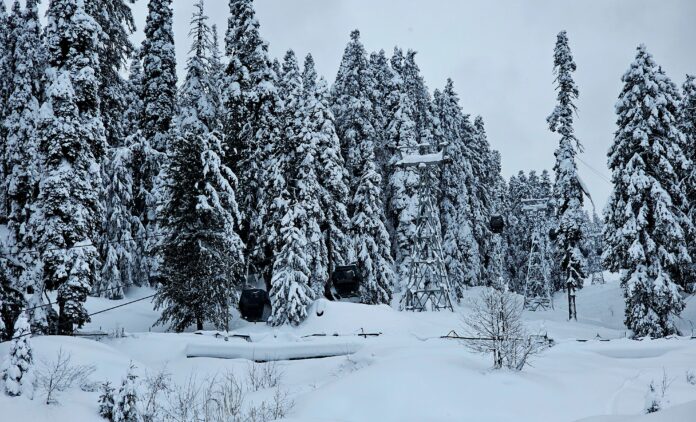
Night temperatures across the Kashmir Valley have increased as the severe winter phase known as Chillai Kalan concluded on Friday. This 40-day period, marked by intense cold and frequent snow, typically defines winter in the region.
Officials from the Meteorological Department reported several areas, including Srinagar, experiencing minimum temperatures above freezing. The temperature in Srinagar settled at 1.3 degrees Celsius, a significant rise from the -0.6 degrees Celsius recorded the previous night. This level also exceeded the seasonal average by 2.2 degrees.
Konibal registered a minimum of 1.0 degrees Celsius, while Pulwama and Kulgam noted temperatures of 0.1 degrees and 1.1 degrees respectively. Most weather stations across the Valley indicated temperatures above normal for this time of year.
Despite these increases, colder conditions persisted at higher altitudes. Sonamarg in the Ganderbal district reported the lowest temperature at -10.6 degrees Celsius, although this represented a mild increase from the -11.2 degrees Celsius recorded the previous night. The renowned ski resort of Gulmarg observed temperatures at -9 degrees Celsius, while Pahalgam marked -5.3 degrees Celsius.
Additionally, Qazigund noted a low of -0.3 degrees Celsius, Kokernag recorded -0.6 degrees, and Kupwara observed -3.1 degrees Celsius. These varying temperatures highlight the stark differences between lower and higher regions of the Valley.
Chillai Kalan is traditionally recognized as the coldest period during winter in Kashmir, renowned for its impact on daily life and local ecosystems. Its end signals the transition to the following phases—Chillai Khurd (small cold) lasting for 20 days, succeeded by Chillai Bachha (baby cold) for 10 days.
The Meteorological Department also indicated that a new western disturbance is expected to impact the region starting Sunday. This weather pattern could potentially introduce another series of wet spells, further influencing the climatic conditions for Kashmir.