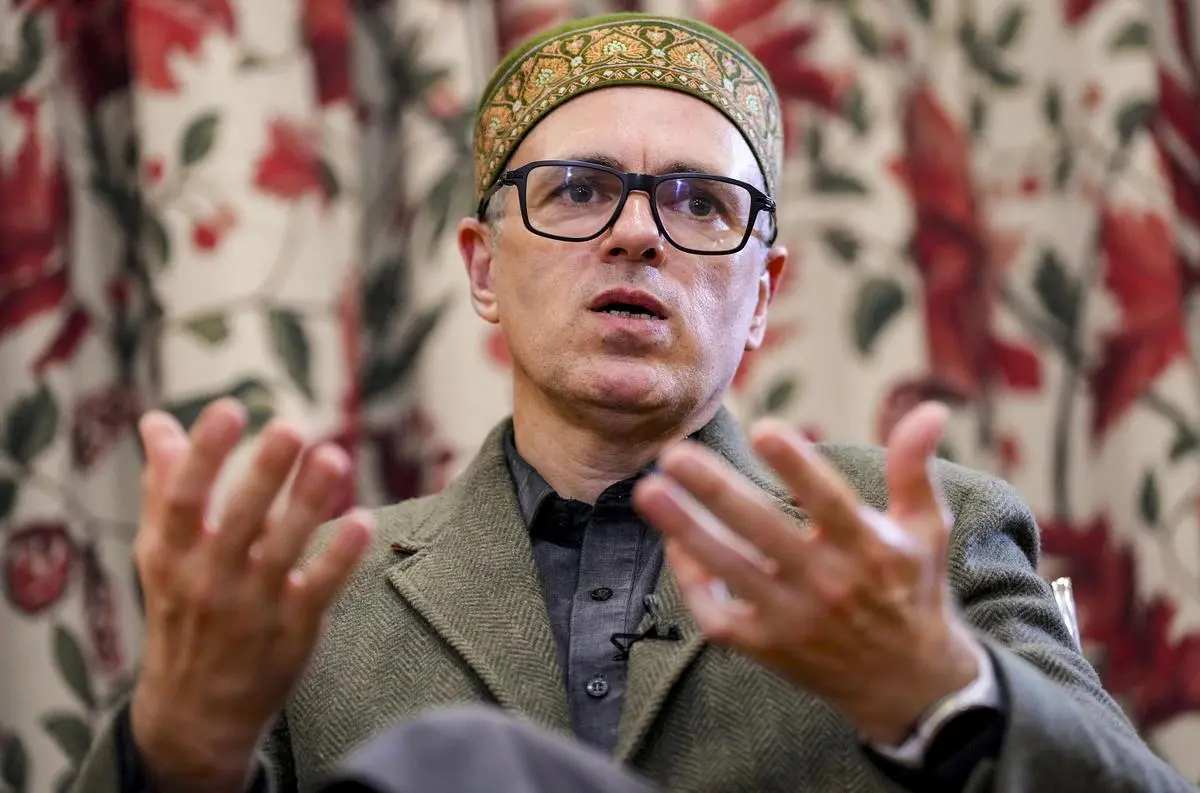
Jammu and Kashmir Chief Minister Omar Abdullah criticized Tamil Nadu Governor Rajendra Vishwanath Arlekar for denying TVK leader Vijay the opportunity to prove his majority in the assembly. On Friday, Abdullah stated it was unjustified to stop the leader from forming the government despite his party falling short of the necessary numbers.
Governor Arlekar rejected Vijay’s claim to form the government, citing that the Tamilaga Vettri Kazhagam (TVK) lacked the requisite 118 seats required for a simple majority in the 234-member assembly. Vijay’s party, even with support from the Congress, which holds five MLAs, remains short of this critical threshold.
Abdullah made his remarks in response to questions about the current political situation in Tamil Nadu. He referred to several Supreme Court rulings that emphasize the need to invite the single largest party to form the government and subsequently allow them to demonstrate their majority on the assembly floor.
“If we see the Supreme Court judgement, then there should be no President’s rule,” Abdullah asserted. He referenced historical instances, including former Prime Minister A B Vajpayee‘s brief government, which had the President’s invitation without an immediate requirement to show parliamentary numbers.
“The President of India invited him, and the government was there for 13 days, but when Vajpayee did not have the numbers, he resigned,” Abdullah explained, highlighting precedent supporting his call for governance continuity.
He concluded by stating that the Tamil Nadu Lok Bhavan has no grounds to halt Vijay’s bid to form the government and that he should be allowed to assemble his team and prove his majority. “If he proves his majority, he will continue, but if not, he will have to resign,” Abdullah added, reiterating the principle of democratic governance as outlined by judicial oversight.
As the political discourse intensifies, it remains crucial for the leaders involved to navigate these challenges within the framework of the law. The outcome of this situation may significantly impact Tamil Nadu’s governance and political stability in the coming days.