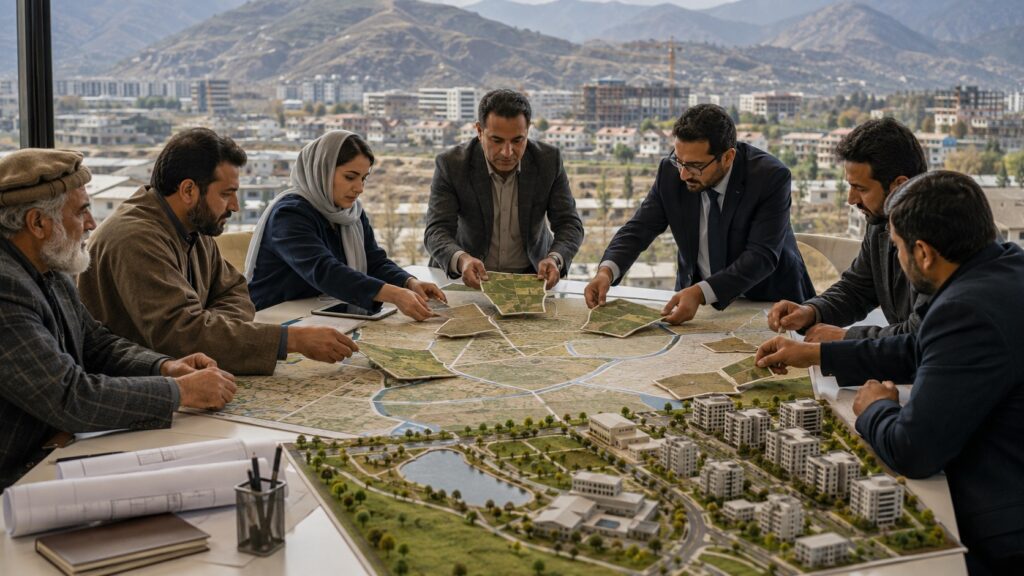
The Jammu and Kashmir government recently announced the launch of its Land Pooling Policy 2026, mandating that at least 70% of landowners give consent for urban development initiatives. This decision was formalized through Government Order No. 173-JK(HUD) dated August 17, 2026, by the Housing and Urban Development Department.
The primary aim of the Land Pooling Policy is to facilitate organized urban growth and bolster infrastructure development. By allowing landowners to voluntarily participate in the development process, the initiative seeks to transform available land into functional urban spaces.
The policy establishes clear guidelines for Developer Entities or consortiums interested in developing a specific land parcel. A land pooling scheme can progress only after securing at least 70% agreement from contiguous landowners, who must complete the necessary registration process.
Prominent among the policy’s provisions is a framework that permits the Developer Entity to retain 60% of the pooled land. The remaining 40% must be surrendered to the concerned Development Authority without any encumbrances. This land transfer aims to enhance city-level infrastructure, recreational spaces, and public amenities, in alignment with existing Master Plans and Zonal Development Plans.
The Developer Entity can utilize the pooled land for diverse developments, including residential, commercial, and institutional projects, as well as essential infrastructural facilities. Importantly, the policy also allows for equitable redistributions among participating landowners, potentially providing developed land or built-up space in exchange.
Underlining the government’s commitment to efficient policy implementation, a Single Window System will streamline the approval processes. The Development Authority will oversee vital responsibilities, such as planning proposals, infrastructure development, and establishing coordination with agencies managing services like water supply and electricity.
To further support stakeholders, the Development Authority will establish a mechanism for dispute resolution alongside marketing housing options for the Economically Weaker Sections. This approach ensures that various community needs are addressed alongside urban growth.
Moreover, the policy introduces a two-tier grievance redressal mechanism. A Grievance Redressal Committee, led by the Designated Land Pooling Officer, must address complaints within 30 days. Dissatisfied parties can appeal to a second-stage committee, headed by the Vice Chairman or Chief Executive Officer of the Development Authority.
The government aims for transparency and efficiency in the land pooling process through a dedicated online portal. This platform will facilitate applications, scrutiny, registration, and the follow-up of land pooling schemes, ensuring all operations remain transparent.
A clear timeline accompanies the scheme, allowing for the formation of a consortium within 60 days (extendable by 30 days) and the submission of related plans to the Development Authority within six months. The overall deadline for completing a land pooling scheme will not exceed five years from the consortium formation date.
The Jammu and Kashmir government assures that after completion, the Developer Entity will maintain the developed areas, with ownership transferring to local urban bodies only after thorough compliance with established norms.
As Jammu and Kashmir strives for urban development, the Land Pooling Policy 2026 positions itself as a transformative initiative that fosters community engagement, supports infrastructure growth, and enhances the urban landscape for residents.