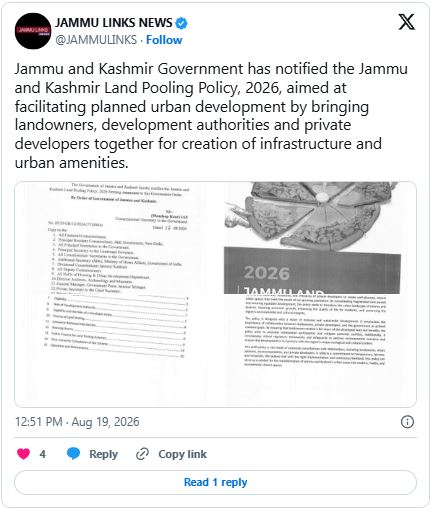
The Jammu and Kashmir government has notified the Land Pooling Policy 2026, mandating a 70% consent from landowners for urban development initiatives. This significant policy, issued by the Housing and Urban Development Department via Government Order No. 173-JK(HUD) on August 17, 2026, seeks to streamline urban infrastructure development through voluntary land aggregation.
The policy aims to facilitate planned urban growth by allowing landowners to become active partners in the development process. It requires that at least 70% of landowners within a contiguous area agree to participate, along with completing a registration process.
Developers must register their interest to initiate a land pooling scheme. One of the notable provisions authorizes the Developer Entity or consortium to retain 60% of the pooled area, while the remaining 40% will be transferred to the concerned Development Authority. This land will support city-level infrastructure, recreational facilities, and essential public amenities, aligning with the applicable Master and Zonal Development Plans.
Furthermore, the land available to developers can host a mix of residential, commercial, institutional, and neighborhood-level public facilities. The policy also introduces flexibility in land redistribution among participating landowners, offering exchanges based on developed land or built-up space.
The concerned Development Authority has a crucial role in executing this policy. It will operate a Single Window System to facilitate smooth approvals and manage planning proposals, infrastructure development, and coordination among local services such as water supply and transportation.
Part of its responsibility includes establishing a grievance-resolution mechanism. This two-tier system will handle disputes arising from the policy’s implementation. The first-stage Grievance Redressal Committee, led by the Designated Land Pooling Officer, must address complaints within 30 days. An appeal can be elevated to a second-stage committee chaired by the Vice Chairman or Chief Executive Officer of the Development Authority.
To ensure transparency and efficiency, the government plans an online process for land pooling schemes. This platform will manage applications, scrutiny, registration, and development rights issuance, allowing for effective monitoring throughout the process.
Timelines for various stages are part of the policy. The formation of a consortium has an initial period of 60 days, extendable by another 30 days. Additionally, the submission of a land pooling scheme must be completed within six months of the consortium’s formation. The total time frame for execution cannot extend beyond five years from this date.
The government outlined that the operation and maintenance of areas developed under the land pooling scheme will fall to the Developer Entity or consortium. Urban Local Bodies will assume responsibility for the infrastructure only after proper handover, adhering to established norms.